Perspective Fundamentals. Part two: Vanishing points:
Using station points and picture planes to prove vanishing points is a task that many people will find to be difficult, but more so unnecessary. But I will try to do it anyway.
Lets go over some the observations we can make with station points and picture planes:
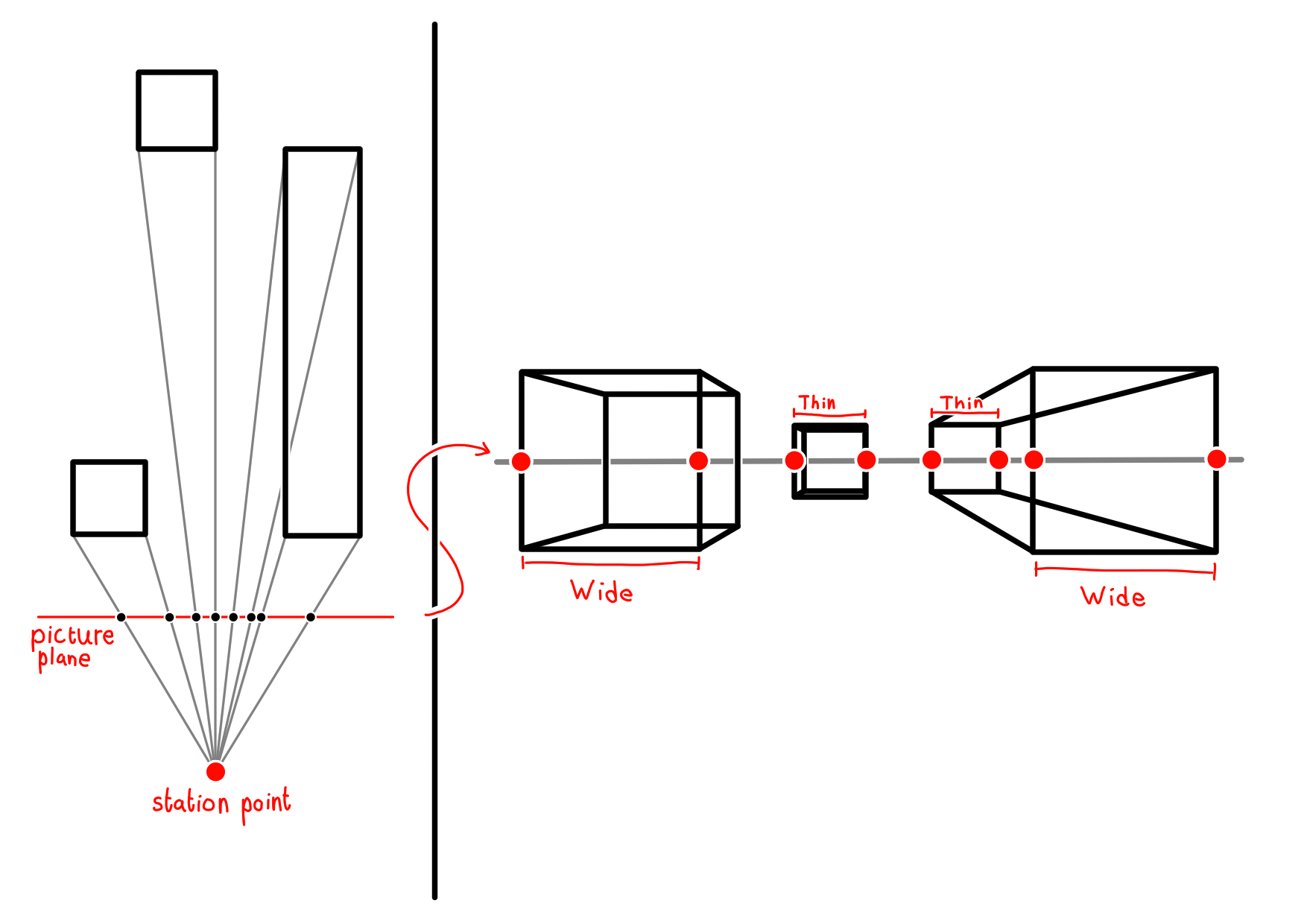
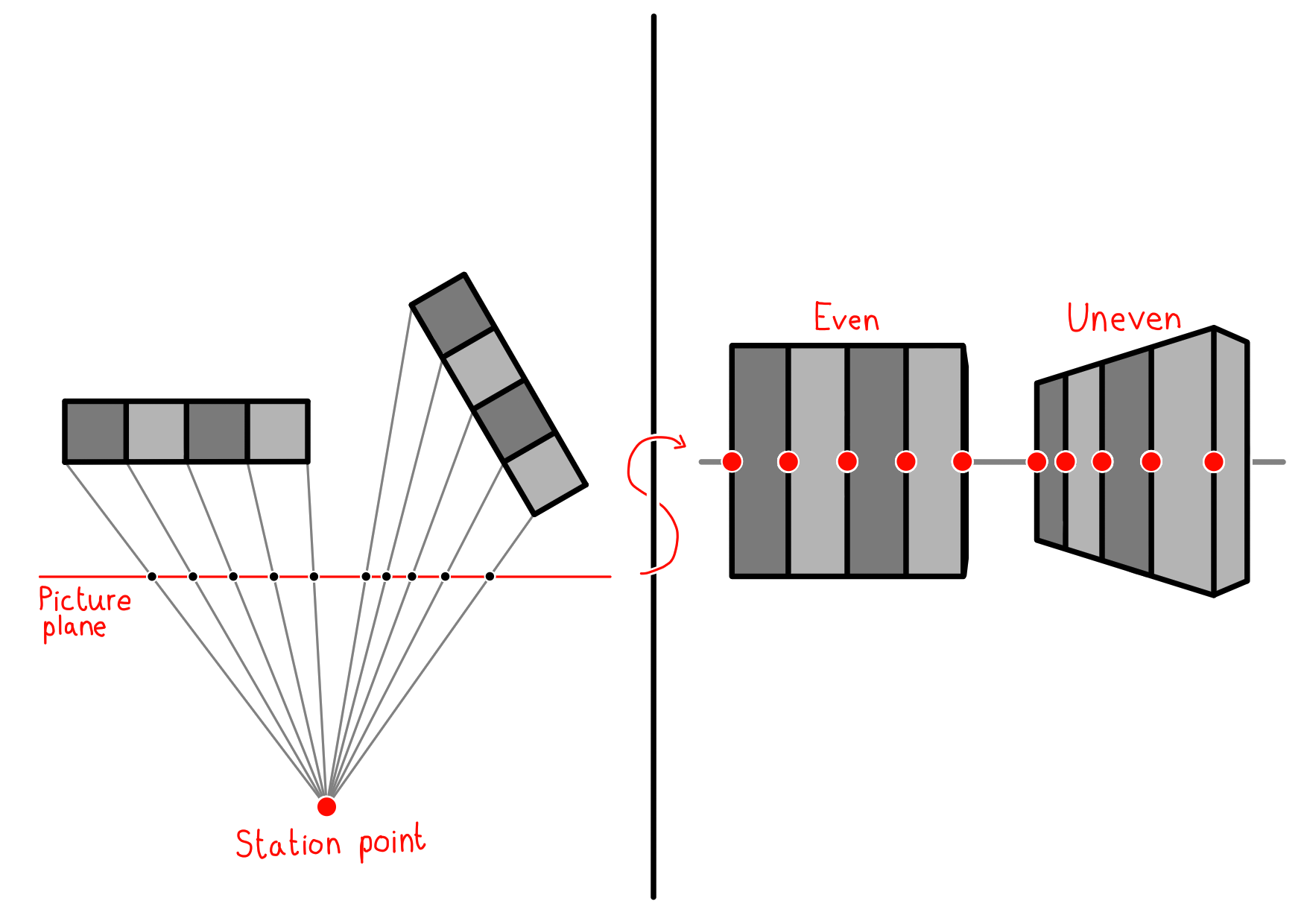
- The farther away a surface is from the picture plane, the smaller it becomes. This applies even when the two surfaces are part of the same object.
- All flat surfaces that are parallel with the picture plane do not experience any distortion other than size.
- A straight line, although its angle and length can change, it will always remain a straight line.
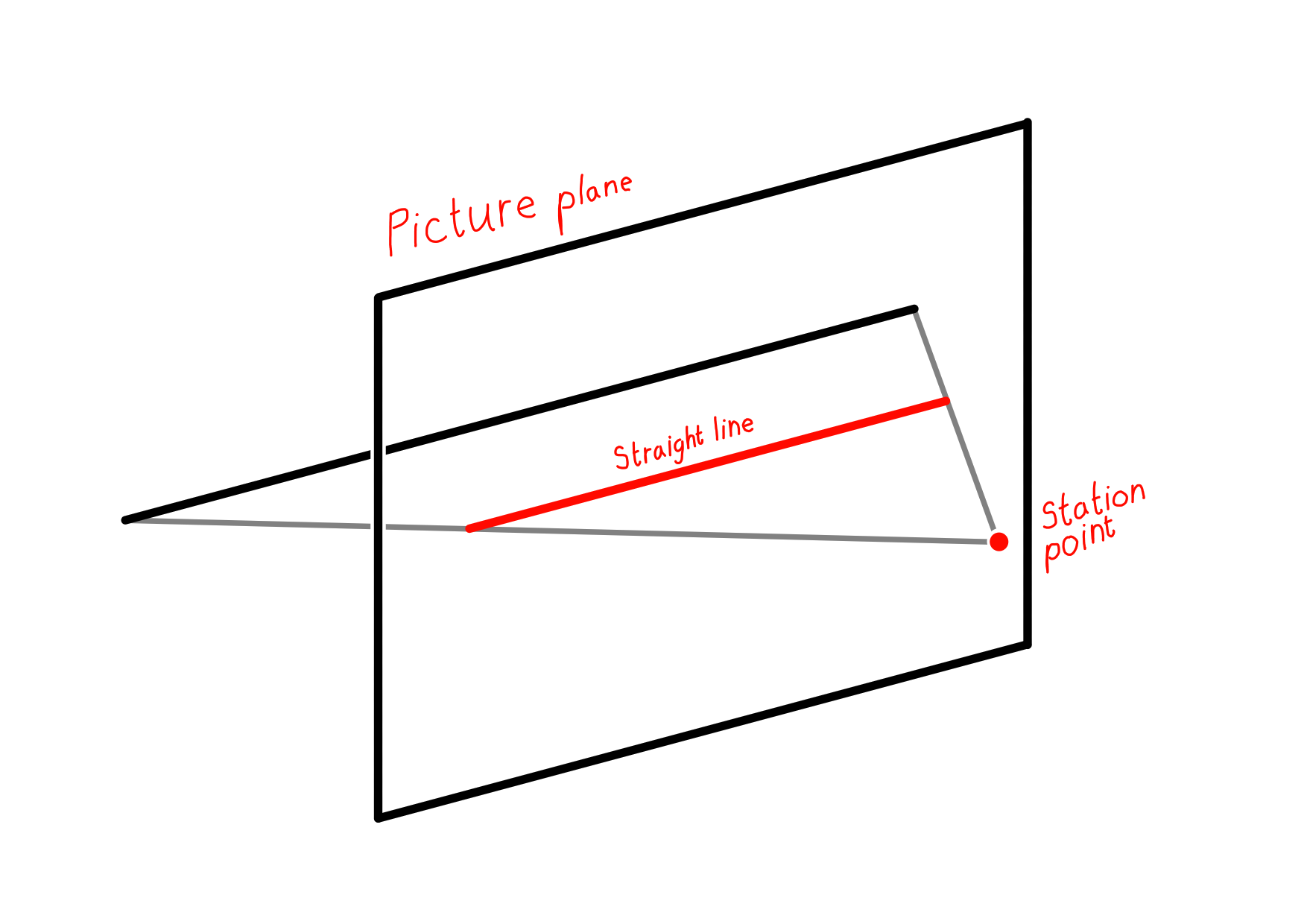
(All of these are assuming that the picture plane is a flat plane. If we were to curve it we would get curvilinear perspective. But that will be covered at a later time.)
Let's put these together.
Imagine that you were tasked with figuring out how to draw a grid of squares lying on the ground in front of you. How would you go about doing that?
Let's assume that one of the grid's sides is parallel with the picture plane. Knowing observation 1 and 2, we can figure out that its horizontal lines should be drawn as a series of perfectly horizontal lines with even intersections that get shorter as they move farther away.
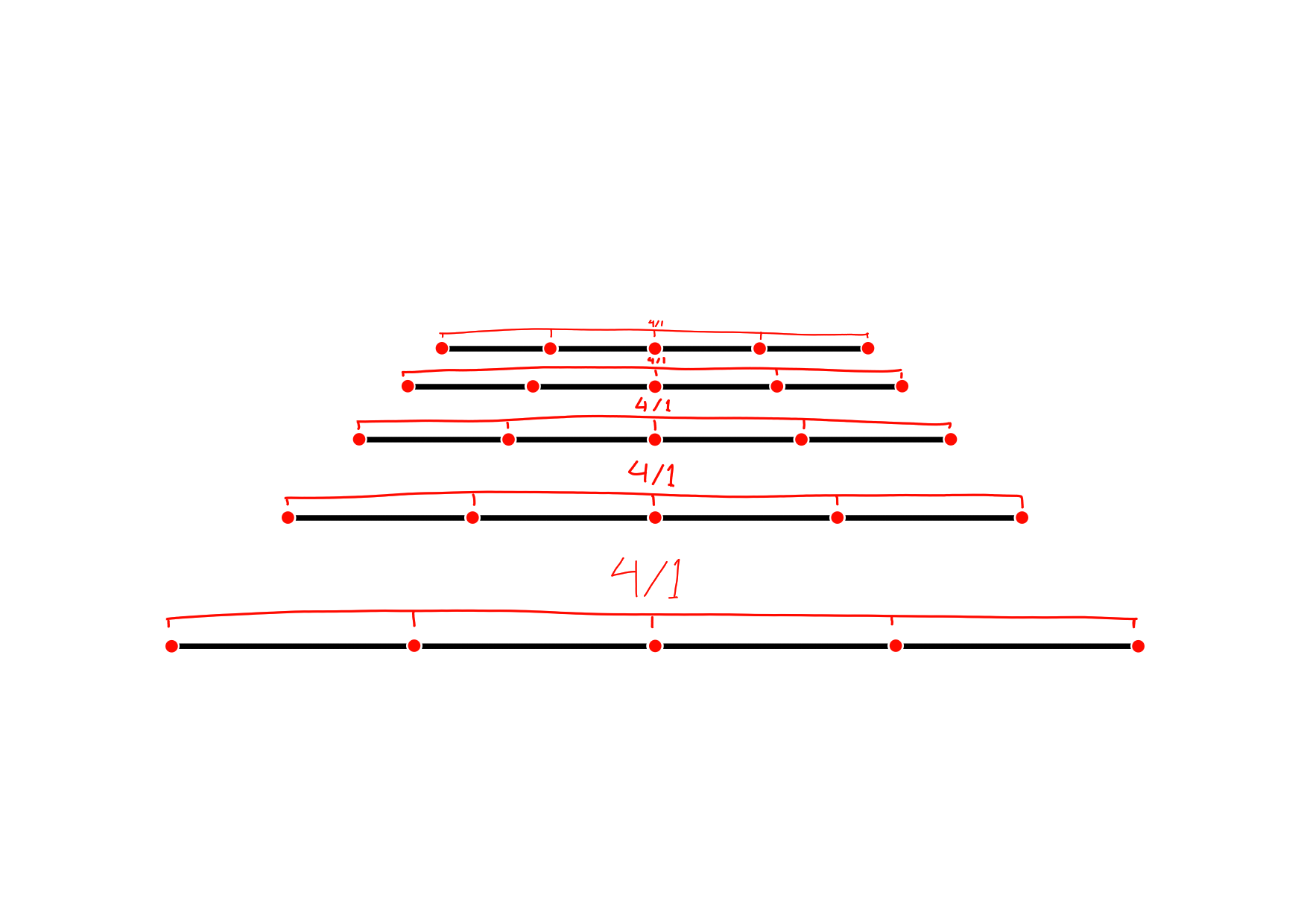
Applying observation 3, we can tell that the vertical lines passing through these intersections have to remain straight. These lines can also be used to make sure that the degree that the horizontal lines shrink remain consistent.
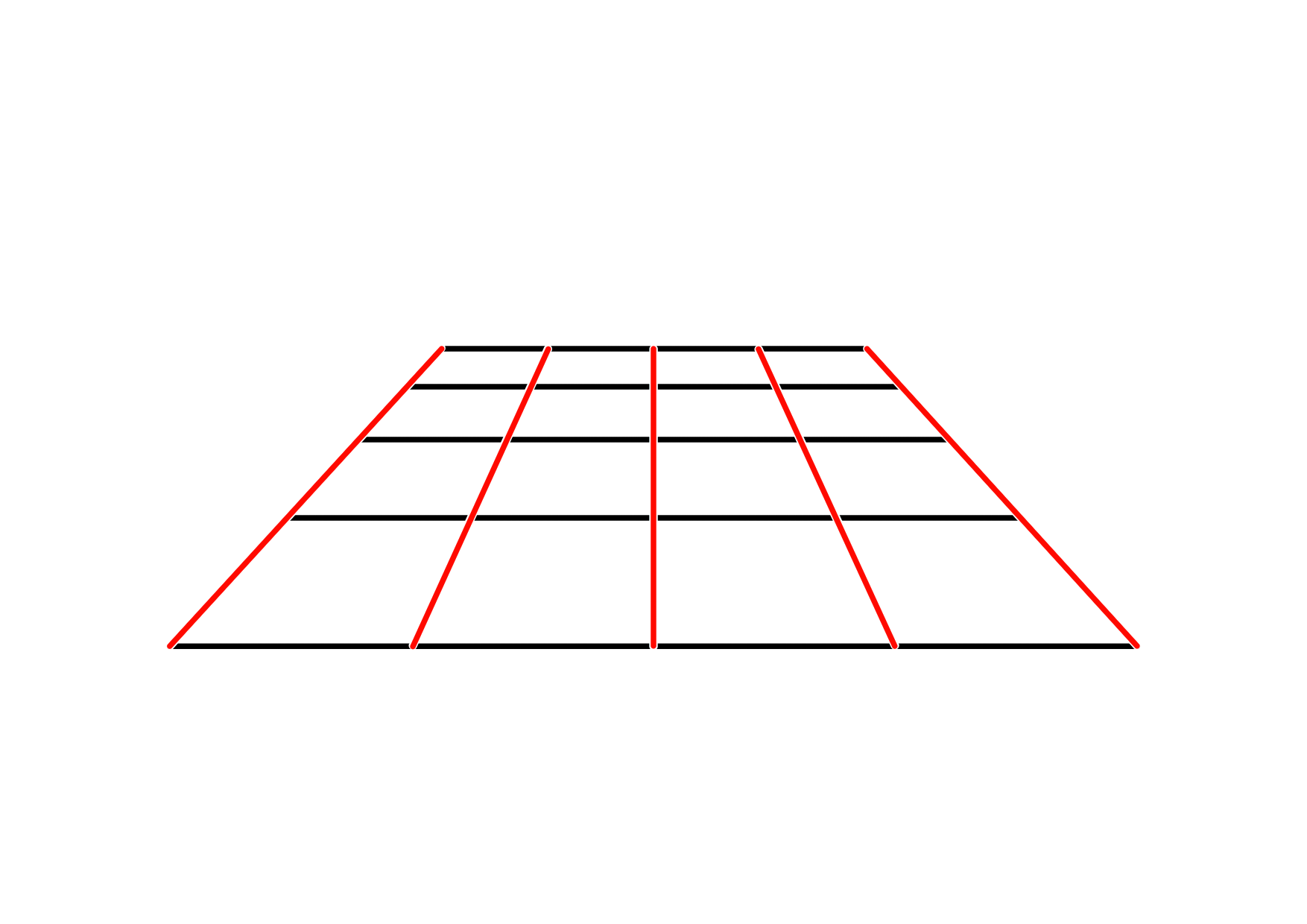
Now, let's take a closer look at those vertical lines. How would they behave if we were to extend them further, beyond the grid?
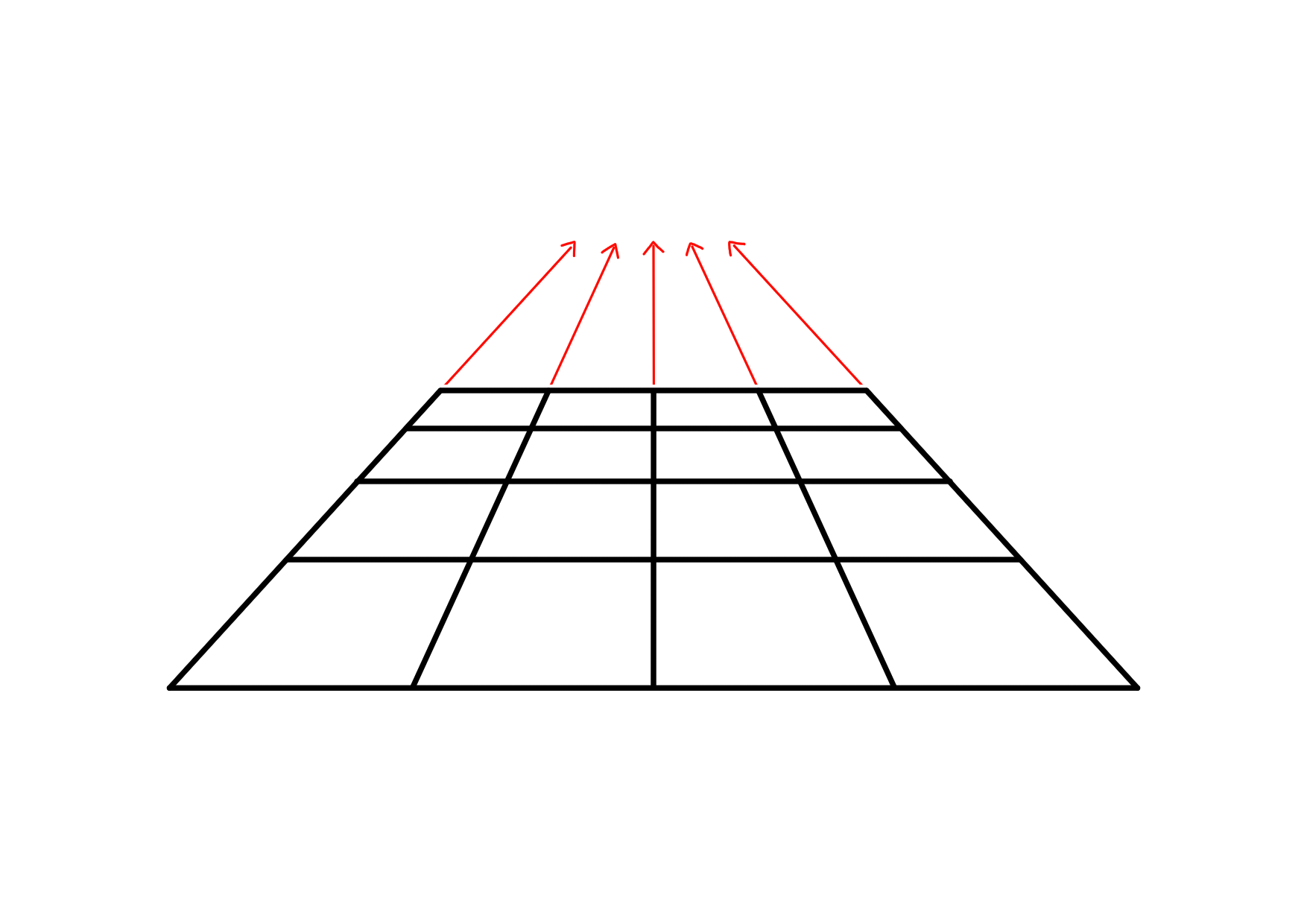
They would appear to move closer together. However, if we were to ever create a horizontal intersection, we would see that their relative distance between each other would always remain the same. As such, no two lines can ever cross over each other before the other ones. It is only once the lines have been extended into infinity that they will all appear to converge all at the same point.
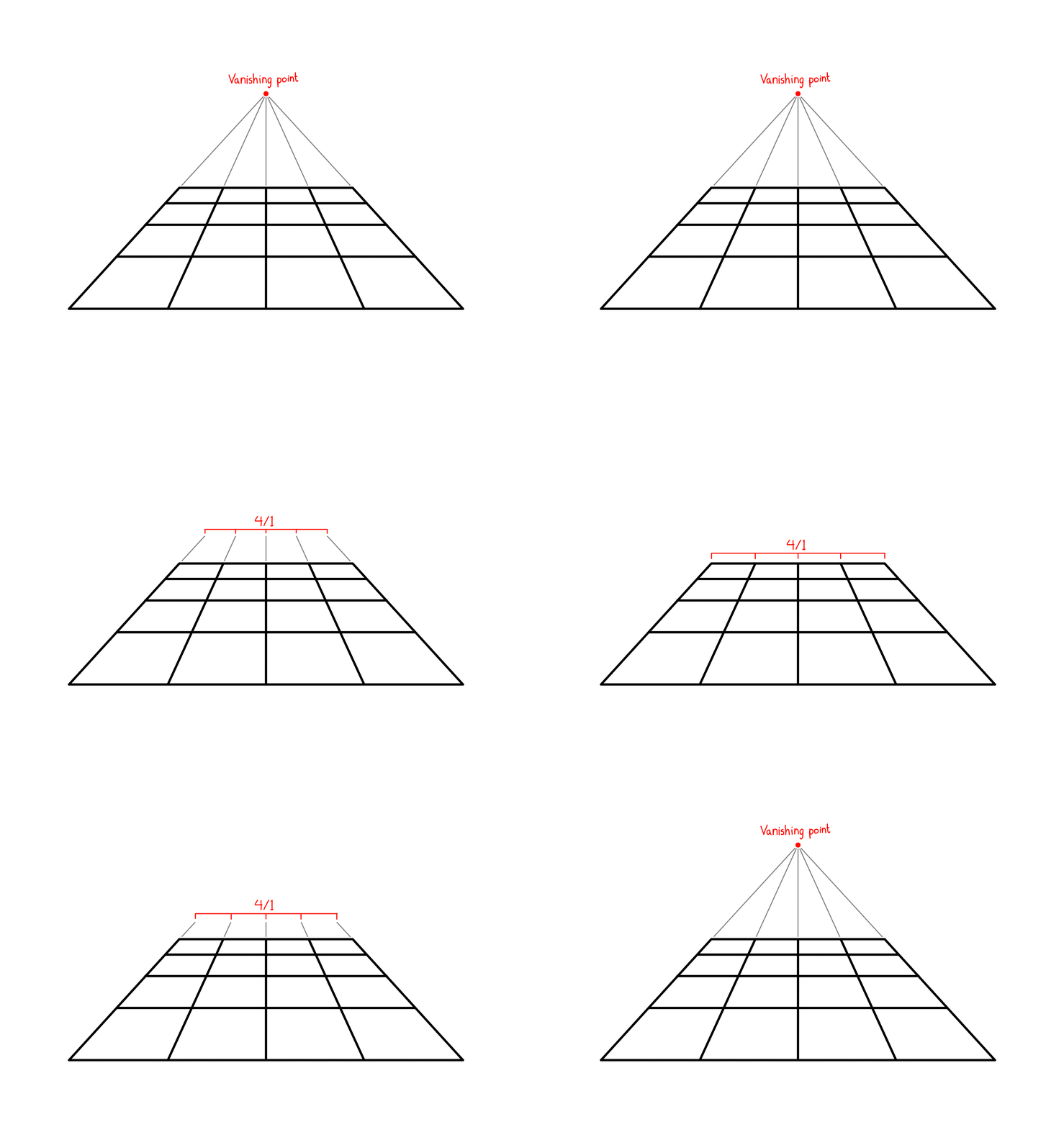
Giving us our vanishing point.
It is this that serves as the largest cornerstone of perspective. Drawing perspective is often just a matter of identifying parallel lines, finding their vanishing points, and working backwards from there.
Basically, if you want to draw a wall in perspective, all you'll need to do is draw a wall that stretches all the way out into infinity, and then remove the parts you don't need.
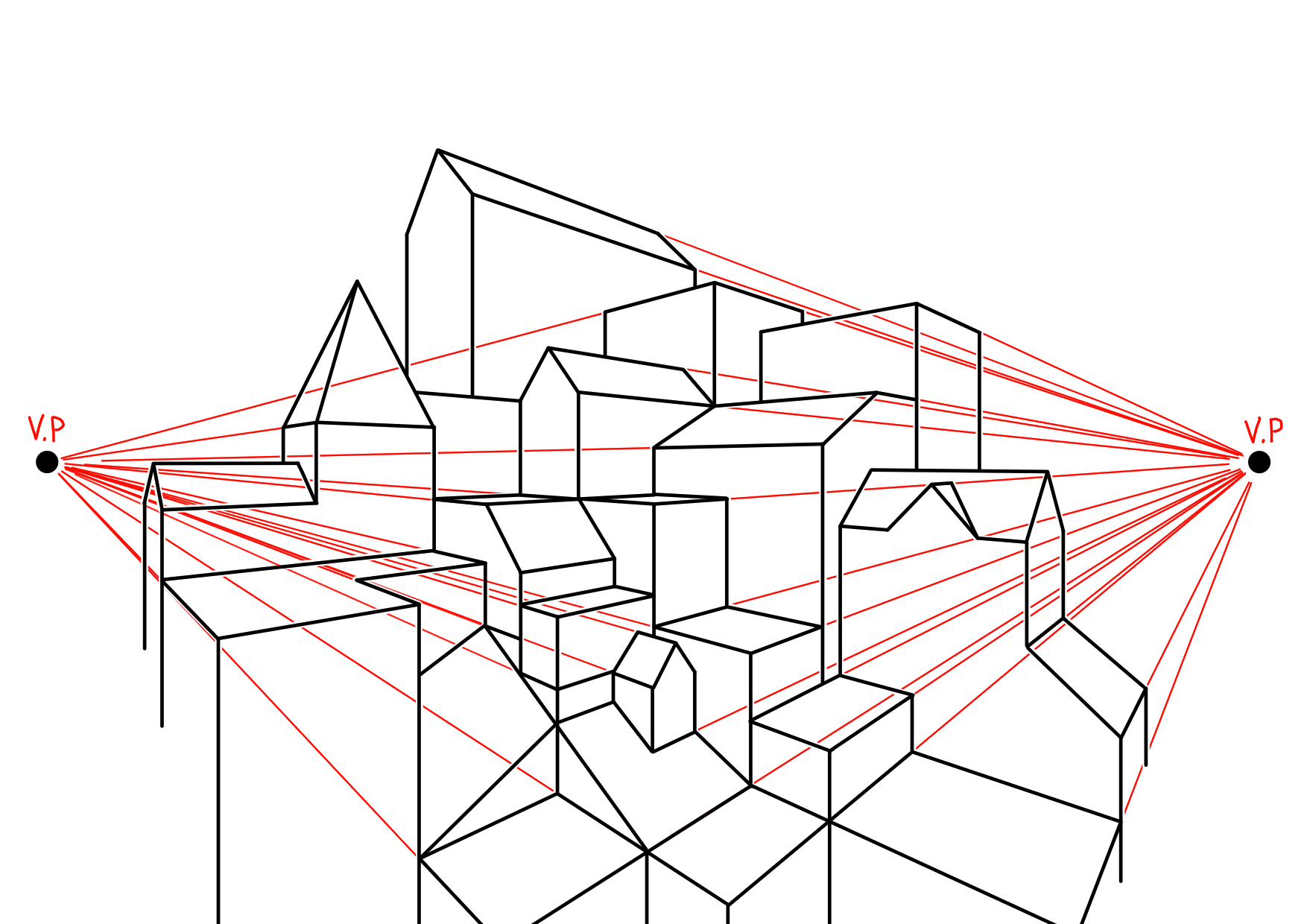
Most man made environments can be broken down into boxes which consist of three sets of parallel lines, conveniently correlating to our three dimensions, height, width and depth. This would require three vanishing points, but by rotating the boxes so that some of these lines are parallel with the picture plane, you can reduce it all the way down to just one vanishing point. Giving us what are often called one, two and three point perspective
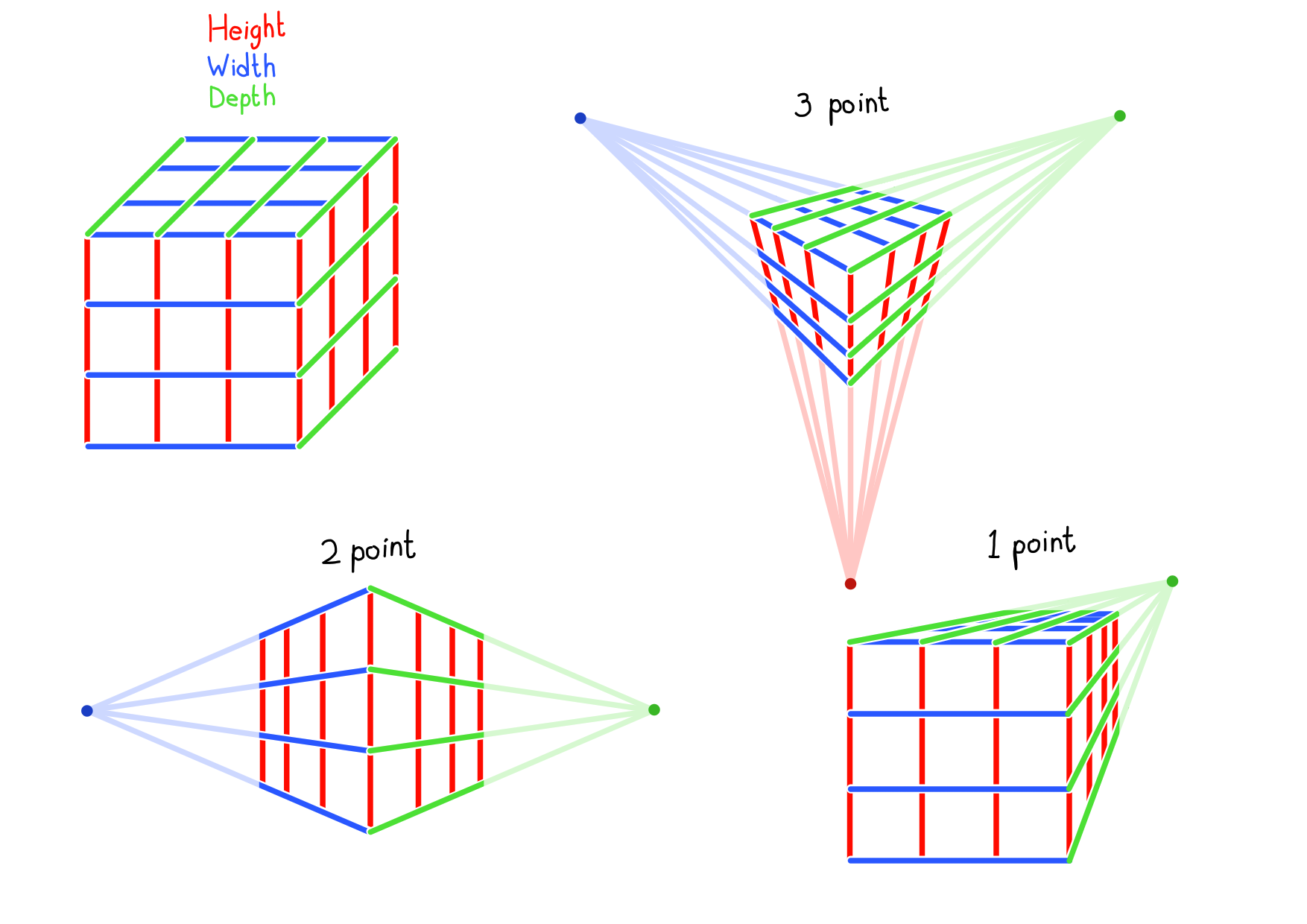
I am not a big fan of the terms one, two and three point perspective. I understand that they are useful for teaching beginners, but I find that a lot of people put far too much emphasis on them. Especially when people start using the terms four, five and six point perspective to describe curvilinear perspective. It feels like people are just bragging about drawing with a bigger number instead of actually coming up with a useful system for categorizing projection methods. I've seen a lot of people who seem to believe that there is this series of projection methods that you are supposed to linearly graduate through as you get better at perspective, instead of viewing each projection method as just another tool that you can use as needed.
Besides, there are plenty of times when you will need more than three vanishing points even for linear perspective. You might need to draw multiple boxes that are rotated differently. You might need to draw shapes that are not boxes. There is also a plethora of techniques that will have you add vanishing points for lines that do not form the outline for an object, but are instead for lines that you could draw through empty space. One such technique is diagonal vanishing points.
Diagonal vanishing points are vanishing points for lines that move diagonally through squares. This is done to control the proportions of the shapes you are drawing, and it can also be used to create a grid of squares, which is what you would use to measure distances in perspective.
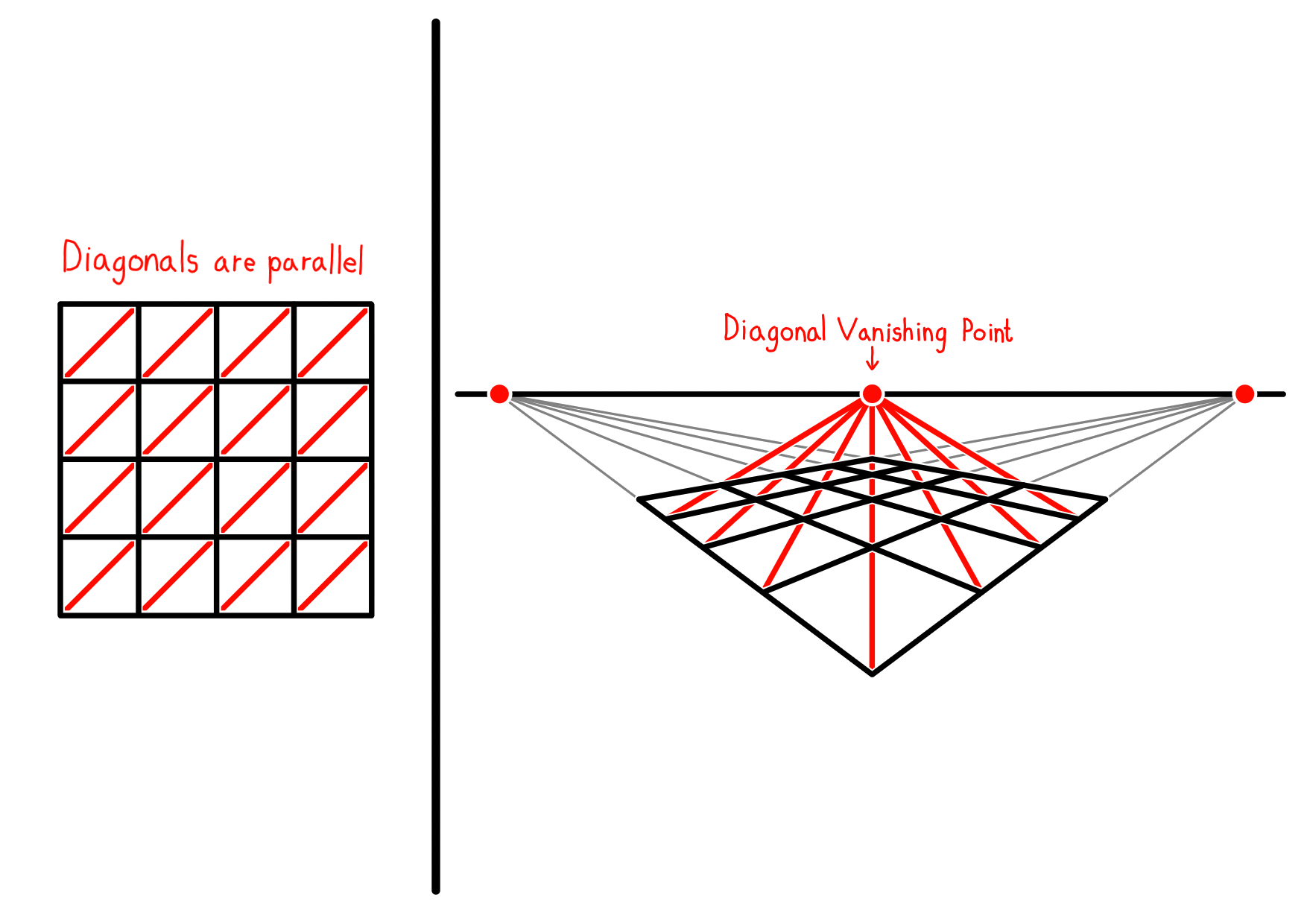
I rarely keep track of how many vanishing points I use for any given drawing, because when you start using a lot of techniques like these, it is not uncommon for a drawing that most people would identify as one point perspective to have required an amount of vanishing points that goes well above six.
This concludes part two.
Back