The simple introduction:
If you have ever learned about perspective before then you have probably been taught it like this. This is how I first learned about perspective, and even though I have a lot of criticisms of it, I still see its value as something that can quickly get people started with drawing perspective if your goal does not involve delving into the deep end. It goes like this:
There are two rules if you want to get started with perspective:
- All receding parallel lines will appear to converge towards a point that we call vanishing points.
- All lines that are leveled with the ground will have their vanishing points appear on the horizon.
Since most man-made environments can be broken down into boxes, and boxes have three sets of parallel lines, you'll need up to three vanishing points depending on how the scene is set up and how the camera is rotated.
One Point Perspective:
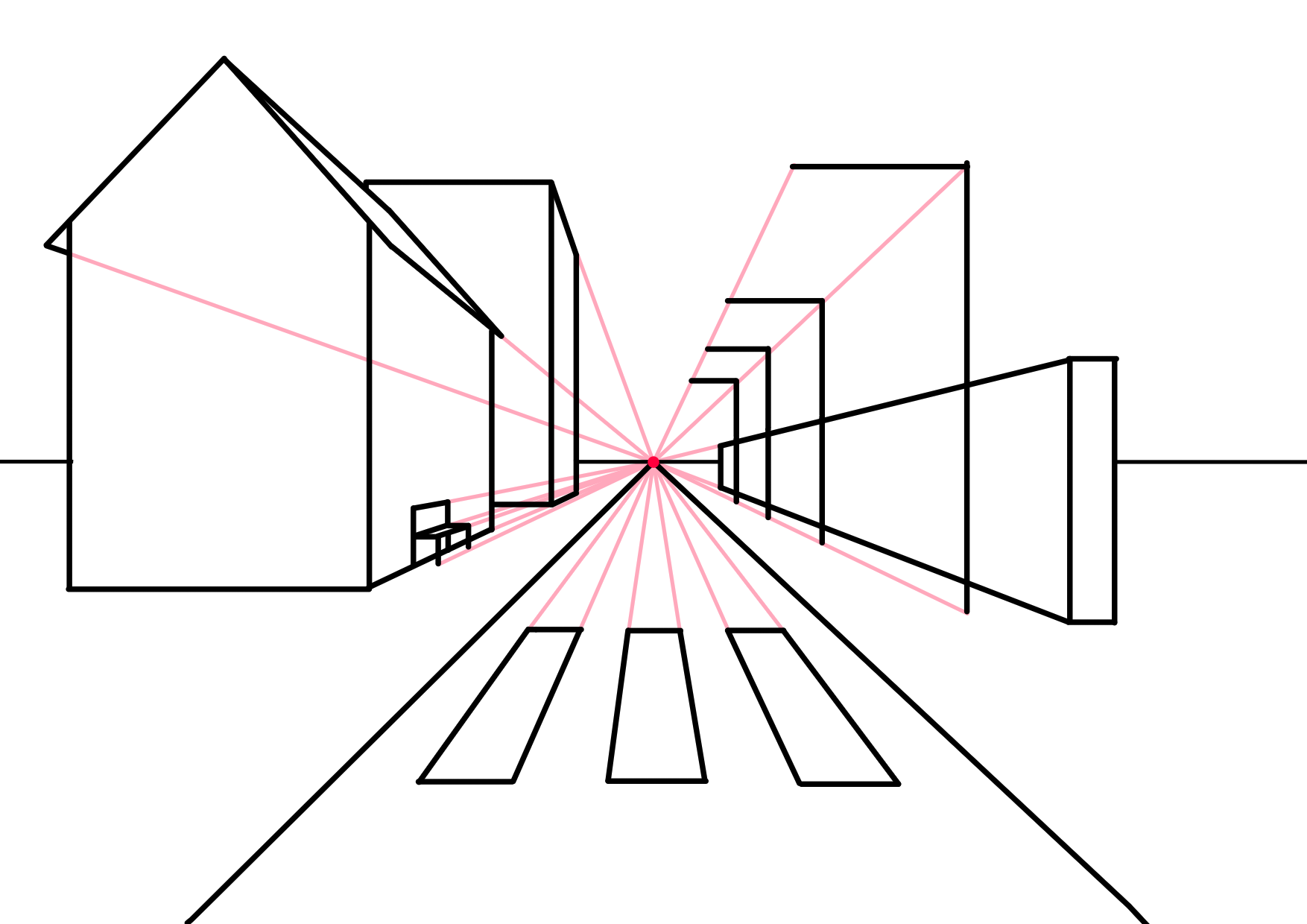
Only one set of parallel lines are receding towards a vanishing point. Notice how the surfaces that are facing us are drawn relatively simple with their vertical and horizontal lines being drawn perfectly vertical and horizontal on the canvas.
Two Point Perspective:
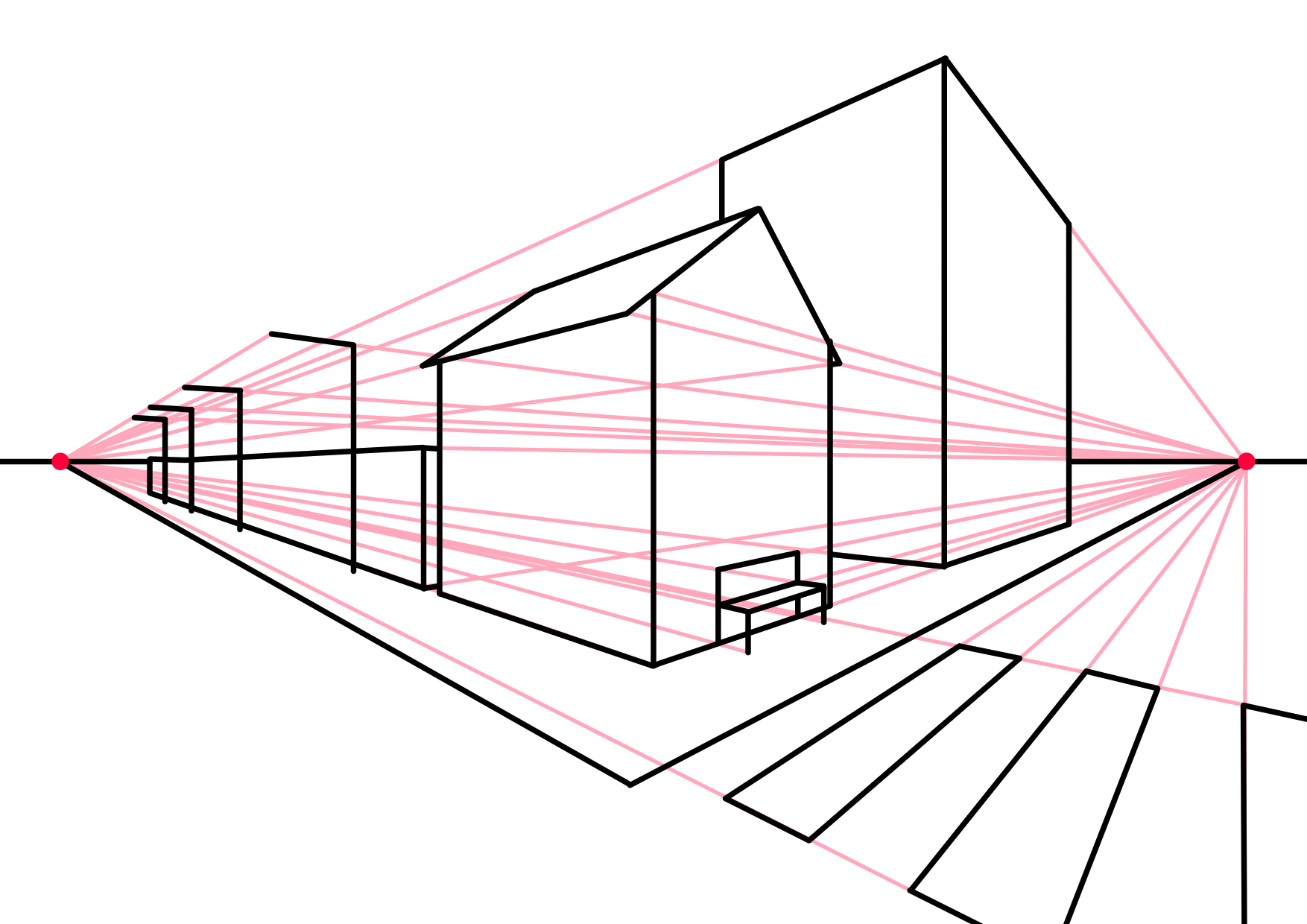
Two sets of parallel lines are receding towards a vanishing point. The surfaces that were previously facing us are now viewed from an angle and have their horizontal lines converge towards a vanishing point. only the vertical lines are drawn parallel on the canvas.
Three point perspective:
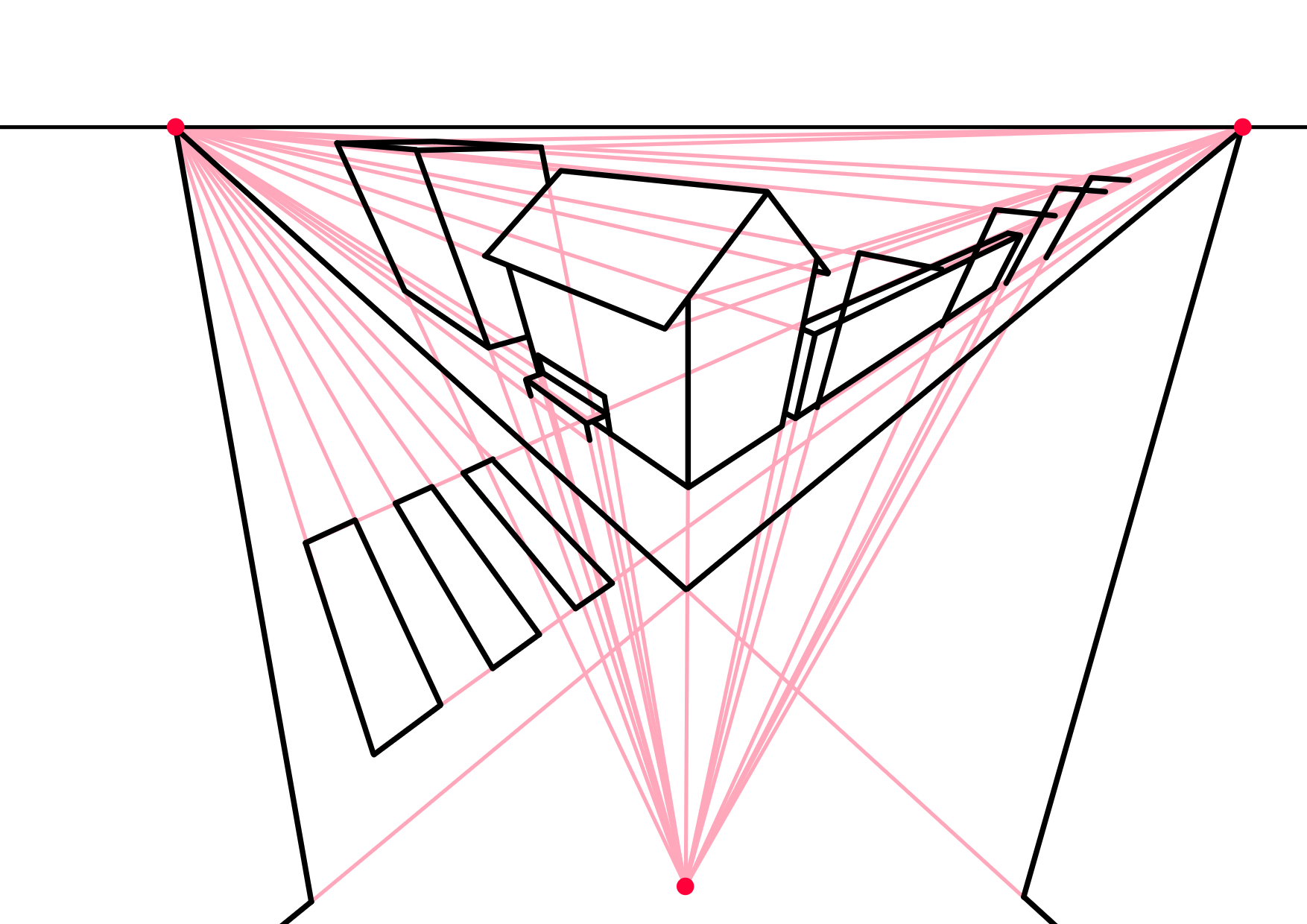
All sets of parallel lines converge towards a vanishing point. Usually only used when the camera needs to be angled up or down.
Most people will usually refer to this as the fundamentals of perspective. I don't. This is because I believe that fundamentals should refer to basic information that you can use to build more knowledge on top of. What I covered above will help you get into drawing perspective quickly, but if your goal is to understand more advanced concepts then I recommend that you read through 'the basics part 1' and learn about picture planes and station points.